
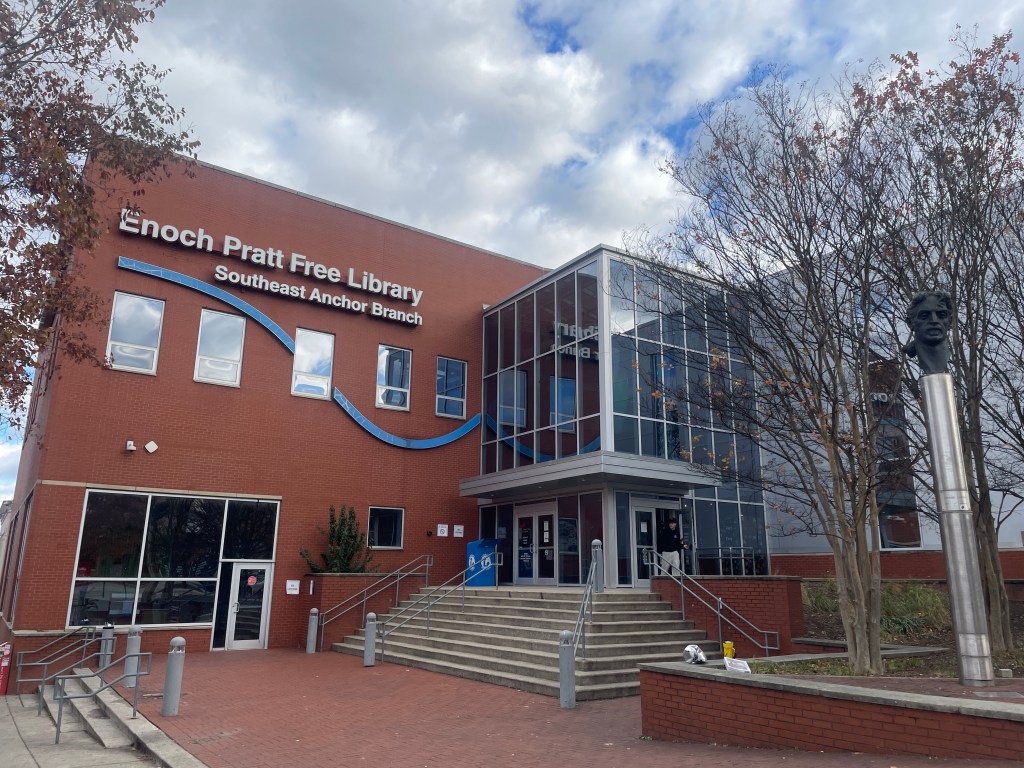
BALTIMORE—The Pratt Free Market (PFM) is the first free grocery store in the Baltimore area. With its colorful, vibrant environment, the market resembles a typical grocery store and welcomes everyone, regardless of socioeconomic status.
Social economic status determines where a citizen is ranked in society’s hierarchy and can predict a person’s life chances. According to the AmeriCorps website, 20% of Baltimore residents live in food deserts, 25% are families with children and 25% are African Americans. Food deserts result from residents needing access to affordable or fresh food.
Lu Bangura, chief of equity and fair practice at the Enoch Pratt Free Library, describes how the PFM concept developed.
“[The] Free market is…an idea that I came into Pratt with when I started three years ago[.] It started with the concept of … community refrigerators, but I quickly learned how much of a task that is to take on,” she said.
The Enoch Pratt Free Library first decided to open the doors of the PFM on Sep. 28. Currently, the market is open on Wednesdays from 11 a.m. – 5 p.m. and Fridays from 2 – 5 p.m.
According to their website, the PFM aims to provide a safe place for community members and address Baltimore’s food insecurity. They provide produce, dry goods and paper goods.
She says the market typically has a line and no ID is required to enter. Some items are limited based on demand, and due to the number of supplies they receive, the market can only open twice a week.
Their website states that on the last Friday of each month, in partnership with Maryland’s food bank, the market closes down to transform into a pantry on the go. The pantry on the go program provides residents with fresh produce.
Libraries and Baltimore’s Health Center have been trying to help address food insecurity. The Enoch Free Library has about four branches in Baltimore and they hold monthly pantries, but the southeast branch is the only location with the PFM.
Bangura explains that based on the number of families they feed and how fast they run out of food, there is a problem within the community.
“We usually sell out… within an hour and a half of opening…We open at 11. There’s people in line from 8 a.m. [on] an average opening day, we service anywhere from 400 to 800 people, and that depends on how many items we have,” she said.
She says that to prepare for the opening of the PFM, the library held engagement sessions with community associations and members and distributed surveys to better understand the food insecurity issue.
She also shares that the PFM is entirely funded; it has received donations from locals and anonymous donors. The locals’ donations totaled $2,500 before the project was started and the anonymous donation helped make the project happen. The library plans to manage the money by applying for more grants and accepting donations.
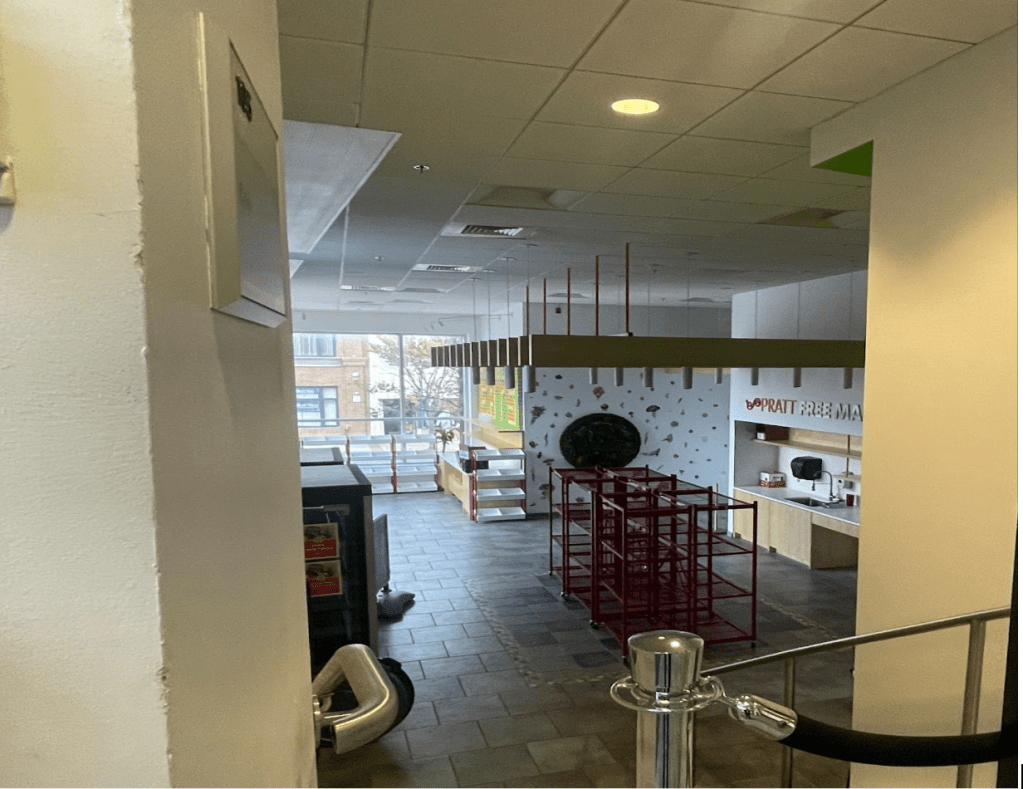
According to a blog post by So What Else Food Rescue Bank, 146,000 Baltimore citizens suffer from a food desert.
John Jones, a homeless person, stated the reason for his food insecurity.
“[The] reason I’m homeless is because I was in the military for 4 years, but I left because of a serious leg injury…I have gone from different shelters in Stafford [and] I’m food insecure because I’m homeless,” he said.
Representatives for organizations tackling food insecurity say Brandon Scott, the mayor of Baltimore, has implemented programs such as electronic benefits transfer (EBT) cards and increased funds for families in need. EBT is a system where citizens can receive benefits and pay funds electronically.
They also shared that the mayor has supported the Baltimore community by working to get more grocery stores in the area and funding organizations that help address food insecurity, like the Pratt Free Library.
According to the mayor’s website, on Oct. 4, Baltimore welcomed the Jumbofresh Supermarket. The Jumbofresh supermarket aims to provide the community with affordable, fresh and nutritional food.
Based on social media posts, non-profit organizations have helped the community by providing cooked meals, holding food giveaways and delivering meals. In order to ensure families in need could have a Thanksgiving meal, Baltimore’s Hunger Project held a food drive from Nov. 11 – 22.
Release Community Outreach, a non-profit organization based in Baltimore, has held turkey giveaways this holiday season, partnering with stores such as Amazon Fresh and Walmart. They also hosted a Thanksgiving dinner for community members on Nov. 28.
According to their website, their goal is to reduce recidivism by encouraging residents with resources to impact their lives positively. They have partnered with Mix church, Higher Dimensions Christian Church and Baltimore Change Center to provide food for families.
Abu Williams, the founder of Release Community Outreach, describes how food insecurity is an economic issue.
“[Many] people just cannot afford groceries at the end of the day…We want to continue to do what we have to do to grassroots organizations[.] The community is going to continue to… do what it has to do to help supplement the people that’s… living on a poverty line,” he said.
Representatives of organizations say that they have received a large number of Hispanics, teenagers and senior citizens struggling with food insecurity. Their goal is to give them healthier options, from fresh produce to vegetables.
Efforts to reach a resident suffering from food insecurity in the Baltimore area failed.
Williams explains how communities need to come together to support those in need.
“Communities are going to have to come together because a lot of the money that’s going to be available [will not] trickle down into the inner cities…So we want to continue to do what we have to do [for] those of us…that have the resources,” he said.

 Christion Billy
One thought on “The Pratt Free Market celebrates 2 months since its opening”