
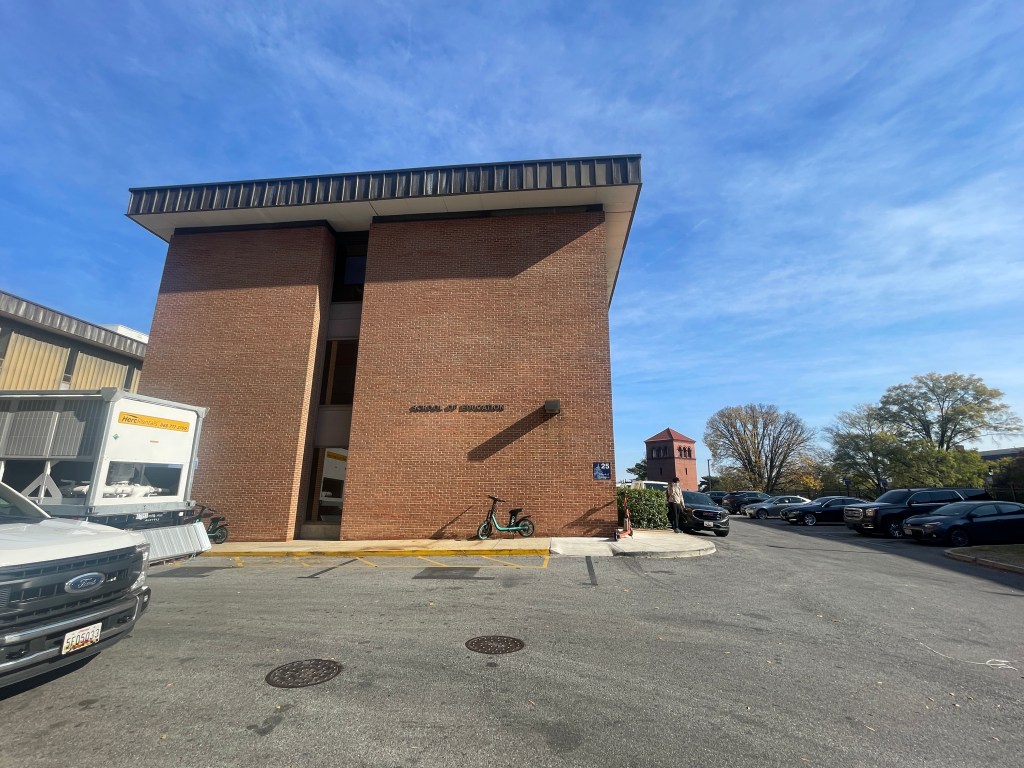
WASHINGTON–On Nov. 5, presidential candidate Donald Trump became the 47th president of the United States (U.S.) and James David Vance became the vice president. Donald Trump’s and James David Vance’s Project 2025 plan includes abolishing the education department.
According to the U.S. Education Department’s website, its goal is to encourage student achievement and preparation by observing equal access to education. The abolishment of the education department could limit the educational rights of students, adults, and professors. Students would not be allowed academic freedom, and professors would not be permitted to have teachable freedom.
Sydnea Lewis, a graphic design professor at the Chadwick Boseman College of Fine Arts, said that this would not affect her job but her teaching style.
“I don’t think it will affect my job, but I think it will affect how I have to teach because I’ll be teaching those … who [will] be affected by this…So those who are coming through the… the new system, and having to matriculate through high school or elementary school, and coming into college, not knowing simply what they should know,” she said.
According to the Chronicle of Higher Education, during the 1976 presidential election, Jimmy Carter promised to create a federal department of education. He created the new department in 1979. The Republicans’ attempt to dismantle the education department goes back to 1980 when Ronald Regan was running for president. Regan’s campaign promised to dismantle the new department.
The Republican party has tried to control education by controlling what kids learn, like the banning of critical race theory. Critical race theory is an academic topic that identifies racism as part of society.
According to the Associated Press (AP), the Republican party has started to control education in multiple states by banning books and the teaching of critical race theory in schools. For example, in 2022, Florida’s Gov. Ron DeSantis signed a bill to ban critical race theory in schools. As a result of the ban, more than 700 books were removed from schools.
Dr. Joe-Joe McManus, a former Florida A&M professor, describes how the Republicans try to demonize educators.
“The idea [this] right has pushed [away is]…[the] mythology of the American Dream, the mythology of westward expansion…all these things that promote white supremacy… So the demonization of educators is really about educators [who] want to teach actual history and believe in the idea of learning from our history, thinking critically, and doing better,” he said.
Jojo Spiker, a graphic design professor at the Chadwick Boseman College of Fine Arts, says if the U.S. education department is abolished, many HBCUs, including Howard University (HU), will suffer. HU receives a large amount of federal funding from the government, and if that funding is gone, it will not be able to pay its faculty.
He also shares that the lack of money to pay faculty can result in the layoffs of many adjunct professors, which can lead to tenured professors having to teach more classes than they usually would. The lack of faculty can also lead to eliminating courses within the departments.
Spiker explains his backup plan for his future as an adjunct professor.
“I’m looking at non-accredited educational institutions, both online and brick and mortar, [and] for other job opportunities. I’m also still working. I have a business that I run…so my focus will shift towards getting more clients,” he said.
He says during the Reconstruction era, black citizens were not allowed to learn. Since then, education has been used to uplift the black community.
The future of the education department is still in the air and professors say that they hope this issue will bring both parties together and that states will try to protect their citizens’ educational rights.

 Christion Billy