
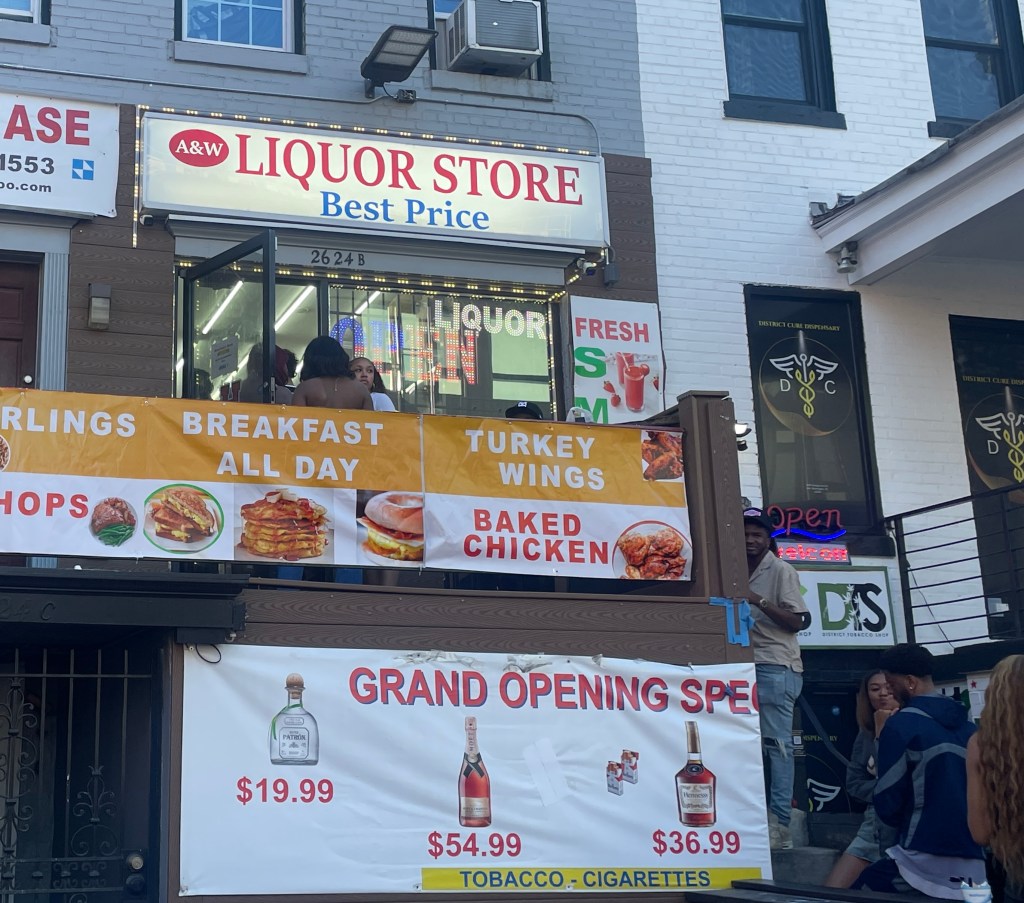
WASHINGTON—Gentrification has caused more liquor stores to move into black neighborhoods than grocery stores, causing some D.C. citizens to travel a long way to the nearest grocery store.
Ward 1 has 45% white citizens compared to 23% Black citizens. White neighborhoods, like Columbia Heights, have Lido, Target, and Giant, while black neighborhoods, like the Howard University (HU) neighborhood, only have Whole Foods. Whole Foods sells organic and expensive food, which has caused residents to search for affordable food elsewhere.
Britnisha Cadet, a freshman nursing major, explains how gentrification affects the Howard University (HU) community.
“There has been a lot of gentrification around Howard, especially when it comes to liquor stores and smoke shops …because it [is] accustom[ed] to college students versus things like grocery stores and…things [that] are… healthy,” she said.
There are about three liquor stores around HU. The Georgia Ave liquor store’s main customers are college students, so they focus their sales on them.
A&W Liquor and Anania Liquor are liquor stores and restaurants for citizens. Both stores attract a mix of people who come for liquor or the food services they provide.
Over the weekend, the A & W Liqour store received a mix of Howard alums and students for liquor or food services. The store also received many Howard students because of the student discounts they give at their restaurant, like free soul food.
Many students say they travel to Columbia Heights for groceries from Target and Lido because of the more affordable prices. In comparison, some attend Whole Foods because of its covenant location.
When grocery stores plan to sell liquor within white communities, they fight against it.
The DCist informed the D.C. community that in 2018, the Safeway within the Dupont community planned to sell liquor, but the residents were against it. They protested inside apartment complexes wearing shirts saying, “Foods, not booze at Safeway.”
Marita Wilson, a social worker, compares the difference between a liqour store moving into a white versus a Black neighborhood
“The white neighborhoods they contested when those little alcohol stores popp[ed] up… They…respond, and they’re involved, and they keep up with what’s going on, whereas, unfortunately, a lot of us don’t pay any attention to [it],” she said.
The Office of Planning (OP) says that by 2025 the District’s Comprehensive Plan (Comp Plan) will be updated. The Comprehensive Plan will inform them of the challenges and opportunities they hope to fix in the next 20 years. From Sept to Dec, the OP will identify the challenges and develop a racial equity scheme to lead the advancement of D.C. 2050.
According to their website, their mission is to plan for the District’s future, hoping to maintain its values of an inclusive city. It guides improvement in D.C.’s neighborhoods by interacting with stakeholders and residents, conducting research and serving as a liaison for historic reservations.
Their website also states that the comprehensive plan aims to develop a positive and long-term vision for D.C. through physical growth, equity, and change. Agencies, residents, businesses, developers, and shareholders typically use the plan to lead development and change toward an improved future.
According to the Outlook for the District’s Next Comprehensive Plan, Black, Indigenous, and People of color have less benefits from the District’s prosperity. They have less access to financial opportunity, healthcare and well-funded schools.
Based on D.C. Hunger’s Findings, this racial inequality resulted from many years of racial exclusion and oppression.
The OP says they are trying to solve the problem of food equality in its Comp Plan for 2025. Solving the problem requires examining the zoning of black neighborhoods.
Lauren Stephens, a D.C. resident, addresses the need for food security in Black neighborhoods.
“We need equal access to food, and food security is a major issue for everybody, but…black communities,” she said.
The Washington Post informed the D.C. community that in March, the Office of Planning (OP) and the Office of the Deputy Mayor for Planning and Economic Development (DMPED) planned to rezone U and 16 Street to accommodate more significant buildings, including housing complexes.
Wilson says that black residents need to get more involved in the issues affecting their neighborhoods.
“We [need] to change their monitoring [and] zoning. We have to get more involved and know what’s going on in our neighborhood,” she said.

 Christion Billy
One thought on “Black neighborhoods in Ward 1 lack access to affordable grocery stores ”